
Understanding the Most Evidence-Supported Approach to Tinnitus Distress
Tinnitus is common. Roughly fifteen percent of adults experience it, and a large share of those people stop noticing it over time without any treatment at all. The patients we see in our offices are, for the most part, the ones for whom that never happened. The sound stayed in the foreground, and it began interfering with sleep, concentration, and mood.
Understanding why that happens for some people and not others explains a great deal about how tinnitus is treated. It also explains why cognitive behavioral therapy, an approach most people associate with mental health care rather than audiology, has become the most evidence-supported intervention available for tinnitus distress.
This article covers what CBT for tinnitus involves, what the clinical guidelines recommend, and how we deliver it at the Capital Institute of Hearing & Balance through a program called Oto.
Why Tinnitus Becomes Distressing for Some People
Tinnitus begins in the auditory system, but the auditory system is not what determines how much it bothers you. Two patients can have nearly identical hearing tests, and the same measured tinnitus pitch and loudness, while one describes it as a minor annoyance and the other cannot work or sleep.
The difference lies in how the brain classifies the signal. When tinnitus gets interpreted as a threat, the emotional and fight-or-flight systems get pulled in alongside the hearing system. Stress hormones rise, muscles tense, and attention locks onto the sound the way it would lock onto a smoke alarm. The brain pays closer attention to signals it considers important, so the tinnitus is then perceived more strongly, which reinforces the sense that something is wrong.
This is a self-sustaining loop, and it is the reason advice like “try not to think about it” does not work. You cannot consciously talk a threat-detection circuit out of doing its job.
Habituation is the process of that loop unwinding. The signal is still present, but the brain reclassifies it as unimportant background information and stops routing attention toward it. Most people habituate to tinnitus on their own. Treatment exists for the people who do not, and effective treatment works by removing the obstacles standing in the way of habituation.
What Cognitive Behavioral Therapy for Tinnitus Involves
Cognitive behavioral therapy is a structured, skills-based approach that examines the relationship between a trigger, the thoughts that follow it, and the emotional and physical reactions those thoughts produce.
Applied to tinnitus, CBT is not an attempt to make the sound quieter or to distract you from it. It works on the interpretation. Patients learn to identify the automatic thoughts that accompany a tinnitus spike, to test those thoughts against their actual experience, and to reduce the physiological stress response that amplifies the perception. Sleep is usually addressed directly, since poor sleep lowers tolerance the following day and the two problems tend to compound.
Over a course of treatment, the goal is not silence. The goal is a brain that no longer treats the sound as an emergency, which is the precondition for habituation.
What the Clinical Guidelines Recommend
CBT is not an alternative or emerging therapy for tinnitus. It carries the strongest recommendations in the field.
The American Academy of Otolaryngology, Head and Neck Surgery issues its highest evidence grade in stating that clinicians should recommend CBT to patients with persistent, bothersome tinnitus. The United Kingdom’s National Institute for Health and Care Excellence (NICE) recommends that clinicians consider digital tinnitus-related CBT for adults whose tinnitus is causing distress. A 2020 Cochrane systematic review concluded that CBT may reduce the negative impact tinnitus has on quality of life, with effects the reviewers considered clinically meaningful.
The practical obstacle has never been the evidence. Very few therapists are trained in tinnitus-specific CBT, waiting lists where those clinicians do practice are long, and the cost of a full course of individual therapy puts it out of reach for many patients. Digital delivery developed largely in response to that gap, which is what the NICE recommendation refers to.
What the Oto Program Is
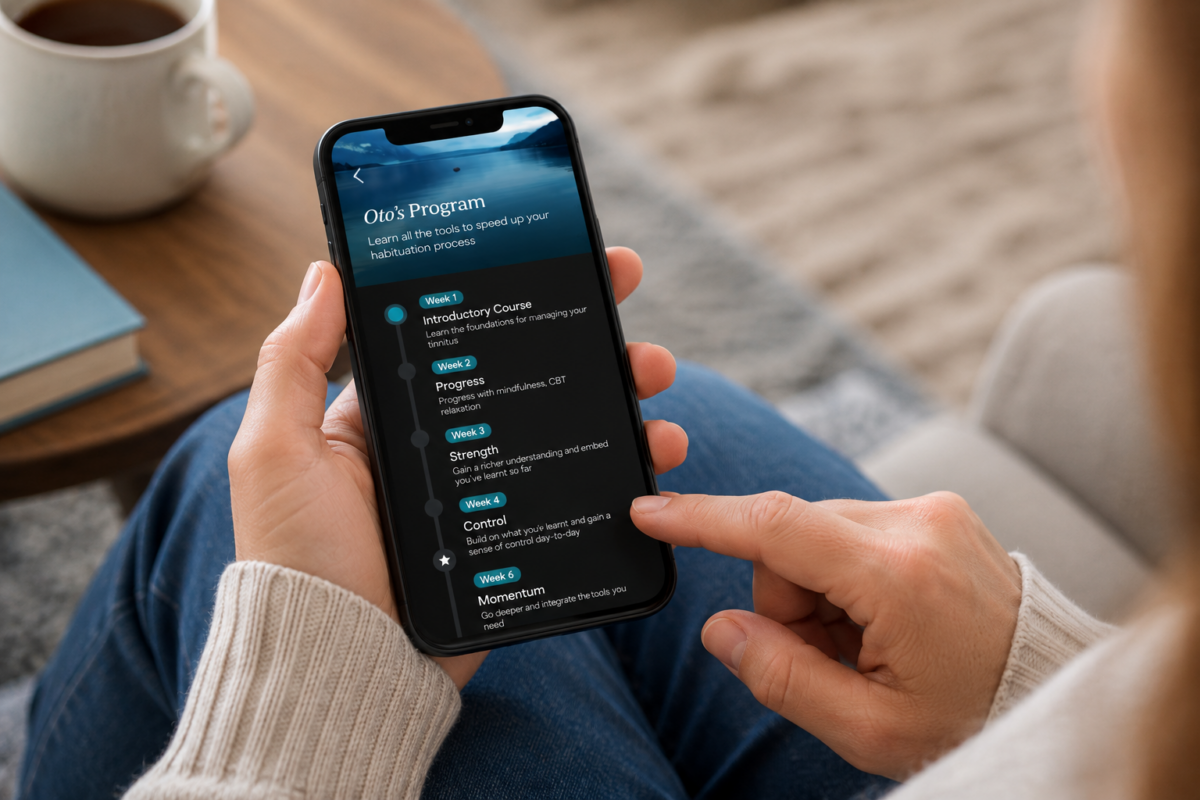
Oto is a tinnitus program that combines audiology care with a structured CBT curriculum delivered through a mobile app. It is used alongside your treatment here rather than instead of it, and it is available only through licensed providers. Patients cannot enroll on their own; enrollment happens through our office as part of a care plan.
The app provides short daily CBT sessions, education about tinnitus mechanisms, mindfulness and relaxation exercises, sleep support, and a library of sound options. Sessions run about ten minutes. Progress data is visible to your audiologist, so what happens between appointments informs what we do at the next one rather than being reconstructed from memory.
More than 200,000 people have enrolled in the program to date.
How Sound Therapy Fits Into the Picture
Sound therapy is often discussed alongside CBT, and the way it is used matters a great deal.
We do not mask tinnitus in our clinic. Masking means introducing sound loud enough to cover the tinnitus entirely, and while it provides temporary relief, it works against the outcome we are trying to reach. The brain cannot habituate to a signal it can no longer detect, so covering the sound tends to postpone the process rather than support it.
Instead, we set therapeutic sound at a mixing level, meaning the point at which the tinnitus blends into the sound around it and the brain is only minimally aware of it. The tinnitus remains perceptible, which is deliberate, but it is no longer the most demanding thing in the environment. For some patients we use notched sound therapy, which is shaped around the individual’s tinnitus frequency.
There is also a form of sound therapy that patients rarely recognize as sound therapy at all, and for many people it is the most important one.
Amplification as Sound Therapy
Hearing loss means your ears are sending the brain less sound than it expects, and two things follow from that. The world around you gets quieter, so there is less ordinary sound for the tinnitus to blend into and it stands out more. At the same time, the brain responds to the missing input by turning up its own internal volume, and that turns up the tinnitus along with everything else.
Restoring the sounds a person has been missing is therefore therapeutic in itself. In many of these cases we do not need to introduce a background signal such as white noise at all. Ordinary environmental sound and speech, made audible again, provide the sound enrichment that supports habituation.
None of that works unless the amplification is accurate, which is why verification matters so much here. No two ear canals are alike, and the same hearing aid programmed to the same settings produces measurably different output in different ears. Manufacturer default settings are calculated from an average ear, not yours.
Using real ear measurement and live speech mapping, we measure what the device is actually delivering inside your ear canal and adjust until soft, average, and loud sounds meet the prescriptive targets calculated from your hearing loss. Without that verification, a patient can be under-amplified in exactly the frequency range where the tinnitus sits, which undermines the hearing benefit and the tinnitus benefit together. We have written in more detail about why real ear measurement matters, including how the procedure is performed.
Sound therapy, in whatever form fits your case, addresses what reaches the brain. CBT addresses what the brain does with it. The two are complementary, and neither substitutes for the other.
How Oto Fits With Our Other Tinnitus Treatments
We strive to include Oto in every tinnitus relief journey we guide, and the clinical care built around it depends on what the evaluation shows. In practice this produces three common pathways.
Oto with an Integrated Tinnitus System
When tinnitus occurs alongside hearing loss, an integrated tinnitus system is frequently the appropriate foundation. These are hearing aids with sound therapy built in, verified with real ear measurement so that restored audibility is doing the work it is supposed to do. Some patients need the additional sound feature and some do not, and that determination comes out of the fitting rather than being decided in advance.
Oto with Lenire
Lenire uses bimodal neuromodulation to influence how the brain processes the tinnitus signal itself. Because Oto addresses the response to that signal, the two work at different points in the same pathway. We have written separately about whether Lenire is a good fit for a given patient.
Oto on Its Own
For patients with normal hearing whose difficulty is primarily distress, sleep disruption, or concentration, the Oto program on its own is often the appropriate level of care.
What the Research Shows
Most tinnitus apps have never been evaluated in a published randomized controlled trial, which is worth knowing when comparing options. Oto is among the few that have.
A 96-participant randomized controlled trial at Flinders University, published open access in 2025, compared Oto against a wait-list control over nine months. The intervention group improved by an average of nine points on the Tinnitus Functional Index at the six-month primary endpoint relative to control, and the effect was sustained at nine months.
A larger trial, the 198-participant DEFINE study led by the University of Cambridge and co-funded by Innovate UK, compared Oto directly against one-to-one therapist-delivered CBT using a non-inferiority design. It is the largest randomized controlled trial of a digital tinnitus therapy conducted to date. Results are in peer review. The full research summary is available on Oto’s research page.
We track outcomes in our own patients using the Tinnitus Functional Index and the Tinnitus Handicap Inventory, obtained at baseline and again at follow-up visits.
What We Have Observed in Our Practice
Since incorporating Oto into our tinnitus care, we have seen meaningfully better outcomes than we saw with our previous approach alone.
Our explanation for this is fairly easy. Tinnitus care tends to break down between appointments. A patient leaves with a sound therapy plan and a set of recommendations, encounters a difficult stretch three weeks later, has no structured support in the interim, and loses momentum before the next visit. The Oto program occupies that space with a defined daily practice, and because we can see how a patient is actually doing, follow-up appointments start from information rather than recollection.
Habituation depends on consistency over months. The patients who stay engaged with a plan are the ones who habituate, and sustaining that engagement is where most tinnitus programs succeed or fail.
What to Expect Over Time
Changes in tinnitus distress tend to appear before changes in tinnitus perception. Patients commonly notice a reduced emotional reaction to the sound first, followed by easier sleep, then improved concentration, and eventually longer intervals during which they simply do not think to check whether the tinnitus is present.
The research on digital CBT shows benefit continuing to accumulate at six and nine months, and our clinical experience is consistent with that. This is not a short course of treatment, and results vary between individuals.

Frequently Asked Questions
Does cognitive behavioral therapy cure tinnitus?
No. CBT does not eliminate the sound. It reduces the distress the sound causes and supports habituation, which is what changes daily functioning for most patients.
Can I sign up for Oto myself?
No. Oto is available only through licensed providers, so enrollment takes place through our office.
Is Oto a substitute for seeing a psychologist?
No. Oto delivers CBT-based education and coping skills within an audiology care plan. Patients managing significant anxiety or depression benefit from mental health care alongside tinnitus treatment.
Do I need to have hearing loss to participate?
No. The program is appropriate for patients with normal hearing as well as those with hearing loss.
If I am fit with an integrated tinnitus system, do I still need Oto?
Sound therapy and CBT address different parts of the problem, so the two are generally used together rather than as alternatives.
How much time does the program require each day?
Roughly ten minutes.
How often will I see my audiologist?
Follow-up intervals depend on your tinnitus relief plan and your progress. We review your outcome measures and program data at each visit and adjust accordingly.
Schedule a Tinnitus Evaluation
If tinnitus is affecting your sleep, concentration, or quality of life, a comprehensive evaluation is the starting point for determining which approach fits your case. We provide tinnitus evaluations at both our Silver Spring and Chevy Chase offices. Schedule an appointment or contact us with any questions.